
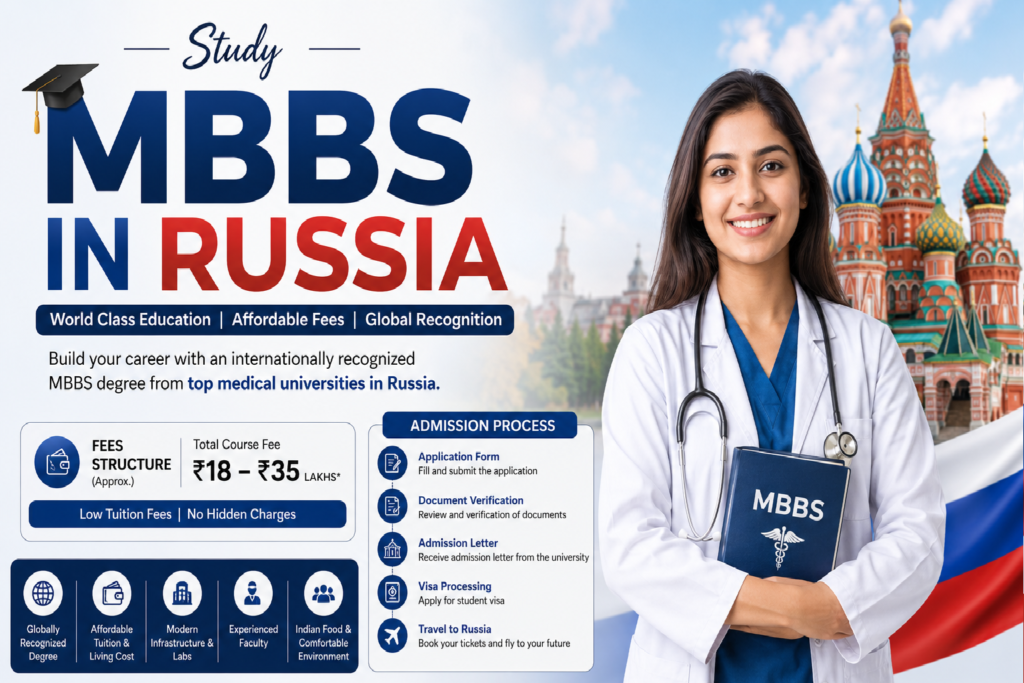
Mbbs in Russia: Every year, thousands of Indian families sit around the dinner table trying to figure out one thing — how to make their child’s dream of becoming a doctor a reality without draining decades of savings. Private medical colleges in India can cost anywhere between 70 lakhs to over 1.5 crore rupees for the full course. Government seats are incredibly limited. And NEET cutoffs keep climbing. So what do smart families do? They look beyond borders.
Russia has quietly become one of the most reliable and affordable destinations for Indian students who want a globally recognized medical degree. The universities are government-funded, the degrees are accepted by the National Medical Commission (NMC) of India, and the total cost of completing the entire 6-year program is often less than one year’s fee at a private Indian college.
This guide covers everything — fees, top universities, the admission process, what life actually looks like as an Indian student in Russia, and how Dream Life Education can make the entire journey smooth and stress-free for you and your family.
Why Are Indian Students Choosing Russia for Medical Studies?
The short answer: value for money, global recognition, and no donation system.
Russia has over 50 government medical universities that are listed in the World Directory of Medical Schools (WDOMS) and recognized by the NMC. This means that after completing the degree and clearing FMGE (Foreign Medical Graduate Examination) or the upcoming NExT exam, Indian students can practice medicine back home.
Here is what makes Russia genuinely compelling for the Indian middle class:
- No donation or capitation fee — you pay only tuition and living expenses
- Medium of instruction available in English at most universities
- 6-year integrated MBBS (including internship) with strong clinical training
- Indian food, Indian student communities, and cultural familiarity
- Safe country with structured student visa process
- Degrees recognized by WHO, UNESCO, and NMC
MBBS in Russia Fees 2026: Complete Breakdown
One of the most common questions Indian parents ask is: what is the actual total cost? The answer depends on which university you choose, but here is a transparent look at all the costs involved.
Annual Fee Structure by University Type
Russian medical universities broadly fall into three tiers based on city and reputation. Moscow and St. Petersburg universities tend to be slightly more expensive, while universities in mid-size cities like Kazan, Ufa, Orenburg, or Volgograd offer excellent education at significantly lower costs.
| University Name | City | NMC Approved | Annual Tuition (USD) | Duration |
| Kazan Federal University | Kazan | Yes | $3,500 – $4,200 | 6 Years |
| Peoples’ Friendship University (RUDN) | Moscow | Yes | $5,000 – $6,500 | 6 Years |
| Crimea Federal University | Simferopol | Yes | $3,000 – $3,800 | 6 Years |
| Volgograd State Medical University | Volgograd | Yes | $3,200 – $4,000 | 6 Years |
| Bashkir State Medical University | Ufa | Yes | $3,000 – $3,500 | 6 Years |
| Orenburg State Medical University | Orenburg | Yes | $2,800 – $3,500 | 6 Years |
| Ural State Medical University | Yekaterinburg | Yes | $3,000 – $4,000 | 6 Years |
| Saint Petersburg State Medical University | St. Petersburg | Yes | $4,500 – $5,500 | 6 Years |
Note: Fee figures are approximate and subject to change. Contact Dream Life Education for the latest confirmed fee structures.
Full Cost of Living Breakdown
Beyond tuition, here is what a typical Indian student spends per year while studying medicine in Russia:
| Expense Category | Approximate Annual Cost (USD) | Notes |
| Tuition Fee | $3,000 – $6,500
|
Varies by university |
| Hostel / Accommodation | $600 – $1,200 | University hostel available |
| Food & Daily Living | $1,200 – $2,000 | Indian food available in cities |
| Health Insurance | $150 – $300 | Mandatory for student visa |
| Books & Study Material | $100 – $300 | Most material provided digitally |
| Total Estimated Per Year | $5,050 – $10,300 | Affordable vs India private colleges |
The total 6-year cost (including all expenses) typically ranges from $30,000 to $60,000 USD depending on the university — a fraction of what private MBBS costs in India.
Top Universities for Indian Students: What to Look For
Not every university in Russia is equally suitable for Indian students. Here are the key factors that matter and which institutions consistently perform well on these parameters.
NMC Recognition and WDOMS Listing
This is non-negotiable. If a university is not listed in the World Directory of Medical Schools, your degree will not be recognized in India. Always verify the NMC website before paying any fee to any institution. All universities recommended by Dream Life Education are NMC-approved and WDOMS-listed.
English-Medium Instruction
Most top Russian medical universities now offer MBBS programs fully in English for international students. Some universities follow a bilingual model where basic science subjects are in English but clinical rotations involve Russian patients — which is actually a good thing for language development and real-world exposure.
Indian Student Support Infrastructure
Universities that have been enrolling Indian students for 10 or more years usually have Indian student coordinators, Indian mess facilities, and established cultural networks. This makes a huge difference in day-to-day life, especially in the first year when students are adjusting to a completely new environment.
Clinical Exposure and Hospital Affiliation
A medical degree is only as good as the clinical training behind it. Look for universities affiliated with large government teaching hospitals where students get hands-on patient interaction from the 3rd year onwards. Kazan Federal University, Volgograd State Medical University, and RUDN in Moscow are well known for strong clinical programs.
Admission Process for Indian Students in 2026
The admission process for Russian medical universities is genuinely straightforward compared to the intense competition for NEET seats in India. Here is how it works step by step.
Step 1: NEET Qualification
Since the NMC mandate in 2018, qualifying NEET is a prerequisite for admission to any medical university abroad for Indian students. There is no minimum NEET cutoff score required by Russian universities, but the NMC requires Indian students to have cleared NEET to be eligible to appear for FMGE after graduation. So clear NEET first — even a qualifying score works.
Step 2: Choose Your University
This is where a good consultancy makes a real difference. The choice of university affects your fees, your clinical exposure, your post-study career, and your quality of life for 6 years. Do not just go by YouTube videos or WhatsApp forwards. Speak to a genuine counselor who can match your budget, academic background, and career goals with the right institution.
Step 3: Apply and Get the Invitation Letter
Once you finalize a university through an authorized representative, the university issues an official Invitation Letter. This document is required to apply for your student visa at the Russian Embassy in India.
Step 4: Student Visa Application
You apply for a student visa at the Russian Embassy or Consulate in India (Delhi, Mumbai, or Chennai). Required documents typically include your passport, invitation letter, NEET scorecard, Class 10 and 12 certificates, medical fitness certificate, and passport-size photographs. Processing time is usually 2 to 4 weeks.
Step 5: Travel and University Registration
After receiving your visa, you fly to Russia — most students travel in August or September for the October intake. Upon arrival, you complete university registration, health examination, and hostel allocation. Many universities have dedicated support staff for this process.
Step 6: Begin Your MBBS Journey
The first year typically covers basic sciences — Anatomy, Biochemistry, and Physiology. Russian universities are known for very thorough anatomy training with cadaver dissection, which gives students a strong foundation for clinical years.
Documents Required for MBBS Admission in Russia
- Valid Indian Passport (minimum 18 months validity)
- NEET Scorecard (2025 or 2026)
- Class 10 Mark Sheet and Certificate
- Class 12 Mark Sheet and Certificate (PCB mandatory)
- Birth Certificate
- Medical Fitness Certificate
- 8 Passport Size Photographs (white background)
- HIV Test Certificate (required by Russian immigration)
- Bank Statement showing financial capability (sometimes required)
Life as an Indian Student in Russia: What to Expect
Beyond academics, students and parents often want to know what day-to-day life actually looks like in Russia. Here is an honest picture.
Weather and Climate
Russia is cold — there is no sugarcoating that. Winters in most cities can drop to -15 to -30 degrees Celsius. However, students adapt quickly, university hostels are well-heated, and the university schedule accounts for the climate. Most cities with large Indian student populations now have proper winter gear shops. Interestingly, many Indian students say the cold actually improves focus and study habits.
Food
Indian food is available in most cities with established Indian student communities. University canteens serve affordable meals, and Indian students often cook together in hostel kitchens. Cities like Kazan, Volgograd, and Moscow have Indian grocery stores. You will not be surviving on just potatoes and bread.
Safety
Russia is generally a safe country for international students. Indian students have been studying there for over three decades and the communities are well-established. Like any country, exercising common sense in unfamiliar areas is advised. Universities have security on campus, and Indian student associations provide a strong support network.
Language
You will study in English but you will live in a Russian-speaking country. Learning basic Russian is not just useful — it is genuinely important for shopping, navigating the city, and especially for clinical rotations where you will interact with patients. Most universities offer Russian language courses in the first year, and students pick it up faster than they expect.
FMGE and NExT Exam: The Road Back to India
After completing 6 years in Russia, Indian students need to clear a screening exam to practice medicine in India. Currently, this is the Foreign Medical Graduate Examination (FMGE) conducted by the National Board of Examinations. The government is transitioning to NExT (National Exit Test), which will be common for both Indian and foreign graduates.
FMGE pass rates have improved significantly for students from NMC-recognized Russian universities, especially those who actively engage in clinical training and use preparation resources from their 4th year onwards. Dream Life Education provides ongoing support to students throughout their academic journey, not just at the admission stage.
Why Choose Dream Life Education for Your MBBS Abroad Journey?
There are hundreds of consultancies in India claiming to help students get into foreign medical universities. Many of them are simply agents collecting commissions from universities, with little interest in whether the student actually succeeds. Dream Life Education works differently.
Honest Counseling, Not Sales Pitches
The team at Dream Life Education takes the time to understand each student’s NEET score, family budget, academic strengths, and career goals before recommending any university. If Russia is not the right fit, they will tell you — and suggest alternatives. There is no pressure selling here.
End-to-End Assistance
From the first counseling session to the day you land in Russia, Dream Life Education handles every step — university selection, document preparation, visa application support, airport pickup coordination, and hostel arrangements. Parents often say that what they valued most was knowing there was someone to call whenever something came up.
Post-Admission Support
The relationship does not end once you board a flight. Dream Life Education maintains contact with students throughout their studies, helps with FMGE/NExT preparation guidance, and has dedicated alumni networks that students can tap into. For a family sending their child abroad for the first time, this continuity of support is invaluable.
Transparent Fee Information
Dream Life Education believes that families deserve to know the complete cost picture before making a decision. There are no hidden charges, no surprise fees, and no commissions passed on to students. What you see in the counseling session is what you pay.
Contact Dream Life Education today for a free counseling session. Whether you are an early planner or looking at the upcoming intake, their team is ready to guide you with accurate, up-to-date information and genuinely helpful advice.
Frequently Asked Questions
Is MBBS from Russia valid in India?
Yes, provided the university is listed in the World Directory of Medical Schools and recognized by the National Medical Commission of India. Students must also clear the FMGE or NExT exam after returning to India.
What is the minimum NEET score required for Russia?
Russian universities do not have a NEET cutoff of their own. However, the NMC of India requires Indian students studying abroad to have qualified NEET. Even a qualifying score is sufficient.
Can Indian students get scholarships for MBBS in Russia?
Yes, the Russian government offers a limited number of scholarships under bilateral agreements. These are highly competitive. Most students are self-funded, but the overall cost is still significantly lower than private MBBS in India.
Is MBBS in Russia taught in English?
Most universities offer English-medium programs specifically for international students. Russian language is also taught as a mandatory subject, which becomes increasingly useful during clinical years.
How long does the admission process take?
From application to visa, the process typically takes 4 to 8 weeks. Starting early (March to June for October intake) is advisable to avoid last-minute delays.
Final Thoughts
The path to becoming a doctor does not have to mean selling property or taking on crippling loans. Russia offers a genuine, affordable, and globally recognized alternative for Indian students who are serious about medicine. The key is to make the right choice — the right university, the right support, and the right guidance from day one.
Dream Life Education has helped hundreds of Indian families navigate this journey successfully. If you are a student or a parent exploring options for 2026, reach out to their team for an honest conversation. Your child’s dream of wearing a white coat is closer to reality than you think.